"Is This Passive Income Thing Even Real?" Here's the Part That Is, and the Part That Isn't.
Ask in any forum and you'll get two confident, contradictory answers from people who are both telling the truth. The word "passive" is doing the lying — and once you separate what's genuinely automated from what never stops, the question answers itself.
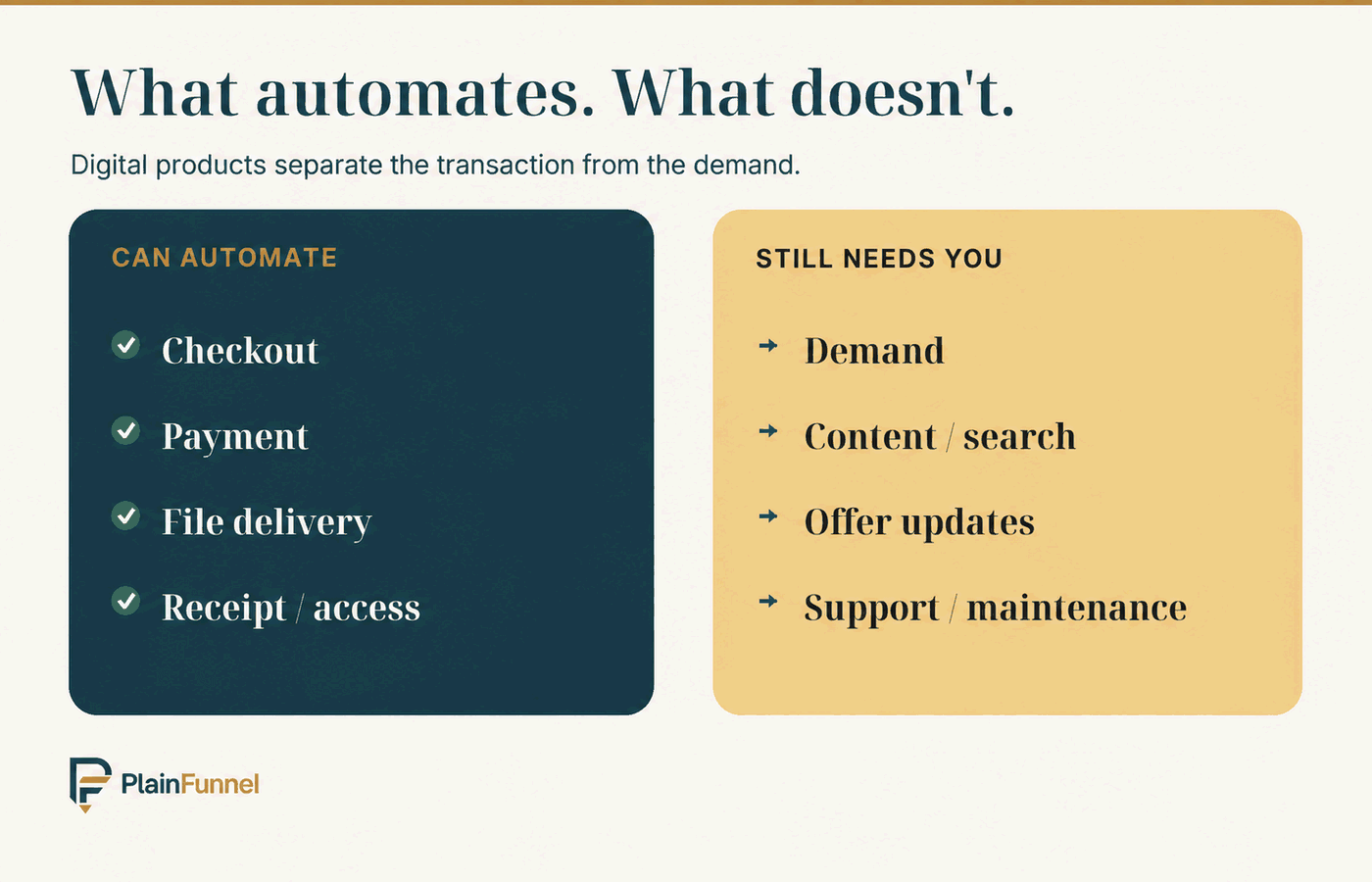
The income can be real. The word passive is where the deception lives — and mostly it's accidental. What's genuinely automated is the transaction: the checkout takes money and delivers a file at 3am without you. What is not automated, ever, is demand. Nobody arrives at your product because it exists. The honest description isn't passive income, it's leveraged income — the work is real and ongoing, but it stops scaling with the number of sales.
Why you get two opposite answers
Ask this in any forum and watch what happens. One person says it changed their life. The next says it's a scam that only makes money for the people selling courses about it. They're equally confident, they're both being honest, and the thread never resolves.
That's not because one of them is lying. It's because "passive income" describes two different things and everyone silently picks one. Separate them and the disagreement mostly evaporates.
What is genuinely automated
This part is real, and it isn't a small thing. Once a digital product is listed:
- The sale completes without you. Payment, delivery, and the receipt all happen while you're asleep, at work, or on holiday.
- There's no stock and no shipping. The file doesn't have to be made again for the hundredth sale. Platform fees, refunds, support and admin still scale with transactions — but the cost of duplicating the product itself is effectively zero.
- Selling twice doesn't take twice the work. This is the actual advantage, and it's the one thing a job structurally cannot offer you.
- On some platforms, the tax paperwork is handled. Gumroad has acted as merchant of record since January 2025, collecting and remitting sales tax worldwide — a genuine administrative saving, not a small one.
The checkout page works while you sleep. Customers don't magically appear while you sleep.
What is never automated
Here's the whole disagreement in one sentence: the product is the easy part, and distribution is the business.
Making the file is a weekend. Getting several hundred qualified people to look at it every month is the actual job, and it does not stop. There's no version of this where you publish something and demand arrives on its own — search traffic has to be earned and maintained, social traffic decays the moment you stop feeding it, and an audience you don't contact forgets you.
This is why the two camps talk past each other. The person who says it works built distribution, and often forgets to mention it because to them it's just "posting". The person who says it's fake made a good product, listed it, and waited — which is the single most common way this fails.
The maintenance nobody puts in the video
Even a product that sells steadily is not finished. This is the list that gets left out of the pitch, and it's the fairest way to judge whether the trade suits you.
| What comes back | Roughly how often | Why it exists |
|---|---|---|
| Listings expire and need renewing | Etsy listings run four months | The fee is charged whether or not anything sold |
| Content upkeep | Ongoing | Traffic decays when you stop publishing; old pieces go stale or wrong |
| Link rot and tool changes | A few times a year | Tools you referenced change their interface, pricing, or disappear |
| Platform policy and fee changes | Unpredictable | Fees move, rules change, and licences get revised without announcement |
| Refunds and the occasional chargeback | Small but permanent | Digital goods attract both; a chargeback costs more than the sale |
| The support inbox | Every week there are sales | "How do I open this", "wrong file", "does it work on my phone" |
| Tax and admin | Quarterly or annually | It's a business, and it's treated as one whether or not you feel like one |
None of that is dramatic. For some products the recurring work stays light; for others, support, updates and traffic add up to a workload you'd notice. But it is not zero, it never becomes zero, and anyone who described this to you as set-and-forget either hasn't done it for long or is selling you the course.
Free guide: the full step-by-step for taking one digital product from idea to a live listing — the real steps, the actual fees, and the numbers most guides skip. Get it free →
The honest reframe: leverage, not absence of work
Strip the marketing off and what's left is genuinely valuable, just differently shaped than advertised. In most work, output is tied to hours: stop working, income stops immediately. With a digital product, the link between effort and units is broken. One file can be sold a thousand times, and the thousandth buyer doesn't make you build the product again — even though support, refunds and audience upkeep do grow with volume.
That's leverage. It is not the same as passivity, and the difference matters enormously for how you plan. Leverage says the ceiling isn't set by your hours. It says nothing about whether the floor is above zero — that part is still earned, monthly, through distribution.
The obvious next question is *"so how much?"*, and the honest answer is that anyone giving you a figure is guessing or selling. Outcomes depend on the product, the price, the channel, the audience and the market — and the people posting screenshots are, by definition, the ones with screenshots worth posting. We don't publish income claims, ours or anyone's. What we do publish is the arithmetic, so you can put your own numbers in and see what they'd require.
Who this genuinely doesn't suit
Worth saying plainly, because the alternative is you finding out over three months.
- If you need money this month. This is slow at the start — reaching steady traffic on a new shop or site generally takes months of consistent work. Freelancing pays faster and it isn't a lesser choice.
- If you won't do the distribution half. If publishing, posting, or learning search is something you know you'll avoid, the product will sit there. That's not a character flaw; it's a mismatch, and it's better spotted now.
- If you want to stop thinking about it entirely. See the maintenance table. The commitment is small and permanent, which some people find much worse than large and finite.
- If a bad month would hurt. Income from this is lumpy, especially early and especially seasonally. It's a poor fit for a bill that must be paid on a fixed date.
How to test the claim yourself, cheaply
- Ignore the results, read the mechanism. When someone says it worked, ask where their traffic came from. If they can't answer specifically, the story isn't repeatable — by you or by them.
- Check whether the person profits from your belief. Not disqualifying, just information. It applies to us too, which is why this article recommends nothing.
- Do the arithmetic before you commit a weekend. Pick a price and a target, work out the sales, then the visitors those sales require. Our profit calculator does it in a minute, and the traffic number is usually the moment the fog clears.
- Ship one small thing and watch what actually happens. One product, one channel, sixty days. That's a real experiment with a cost you can afford, and it answers this question better than any thread will.
So — is it real?
Yes, with the word "passive" removed. Digital products are a real way to sell something that costs nothing to duplicate, to people who find you through channels you built deliberately, with the transaction running unattended. That's a genuinely good structure, and it is available to ordinary people without capital.
What it is not is a way to stop working. You're trading a time-for-money business for a traffic-for-money business — better leverage, different work, and considerably more uncertainty. Whether that's a good trade depends on facts about you that no article can know.
Is it too late? Isn't the market saturated?
Competition is usually evidence that buyers exist and will pay, which is the hardest thing to establish. "Saturated" typically means "a lot of undifferentiated products", and that's a positioning problem rather than a closed door. It is genuinely harder than it was — but the barrier is distribution, and it always was.
How long before it makes anything?
Longer than the videos suggest, and we won't attach a number to it because it depends almost entirely on distribution rather than on the product. What's reasonable is to expect the first months to be about learning whether anyone wants the thing, not about income.
Do I need an audience first?
No, but you need a plan for attention, and "an audience" is only one form of it. Search traffic works without followers and compounds slowly; social works faster and decays faster. What doesn't work is having no answer to the question at all.
Isn't AI making all of this worthless?
It has made producing files trivial, which pushes the value further toward the parts it can't do for you — knowing what's worth making, and being findable. If your plan depends on volume of output alone, that plan got much weaker. If it depends on a specific audience and a specific problem, less so.
Why should we believe you?
Don't, on our word. We sell digital products, so we have an obvious interest in you believing this is viable — which is exactly why this article carries no income figures, no screenshots, and no product recommendation. Check the arithmetic we publish against your own numbers and judge from that.
Related guides
- Someone asked for a refund and they already have the file — one line from the maintenance table above, worked through in full.
- My customer says they have to pay to open my template — the "how do I open this" ticket from the same table, and the one build decision that stops it recurring.
- I priced it at $3 and I'm barely making anything — the arithmetic, including the traffic each price requires.
- I spent days making a product and nobody bought it — how to check demand before you build.
- Plenty of views, no sales — what to do when the traffic shows up and nothing converts.
We sell digital products, which gives us a commercial interest in this question — so this article recommends none of them, quotes no income, and shows no screenshots. Etsy, Gumroad and Pinterest are independent companies with no relationship to us; platform details change and should be checked at the source. Educational only, not financial advice, and no income claims of any kind.
Get the honest digital-products starter guide
The full step-by-step from PlainFunnel — free, no hype.