I Priced It at $3 and I'm Barely Making Anything. Here's the Math.
Cheap pricing isn't just slower — it's structurally worse, because the fixed fees don't shrink when your price does. Here's what a $3 sale actually leaves you, and the traffic number that decides whether your price can work at all.
Selling platforms charge you two different things: a percentage, which scales with your price, and a flat amount, which doesn't. On a $3 sale the flat part alone is 15% before a single percentage fee applies. That's why cheap products feel like they're barely paying — they are. The fix isn't only the price, though. It's knowing the traffic number your price requires, and whether you can realistically get it.
The part nobody warns you about
You made something, you weren't sure anyone would pay for it, so you priced it low to compete. Now sales trickle in and the payout is smaller than you expected — small enough that you've started wondering whether this whole thing works at all.
The usual advice is to post more, make more listings, be patient. None of that addresses what's actually happening, which is arithmetic. Here is a single $3 digital download on Etsy, in the United States, with nothing hidden:
A $3 sale, all the way down
US example, rounded. Payment processing rates vary by country — the EU is mostly 4% + €0.30, the UK 4% + £0.20. Verify current rates before relying on these.
Fees took 24.5% of that sale. Now look at where it came from. The $0.25 processing charge and the $0.20 listing fee are fixed — they are the same on a $3 sale as on a $300 one. Together they're $0.45, which is 15% of a $3 price on its own. The percentage fees people actually think about, the 6.5% and the 3%, contributed less than half the damage.
The same fees, at four different prices
| Your price | Total fees | You keep | Fees as % of price |
|---|---|---|---|
| $3 | $0.74 | $2.26 | 24.5% |
| $5 | $0.93 | $4.07 | 18.5% |
| $12 | $1.59 | $10.41 | 13.3% |
| $29 | $3.21 | $25.79 | 11.1% |
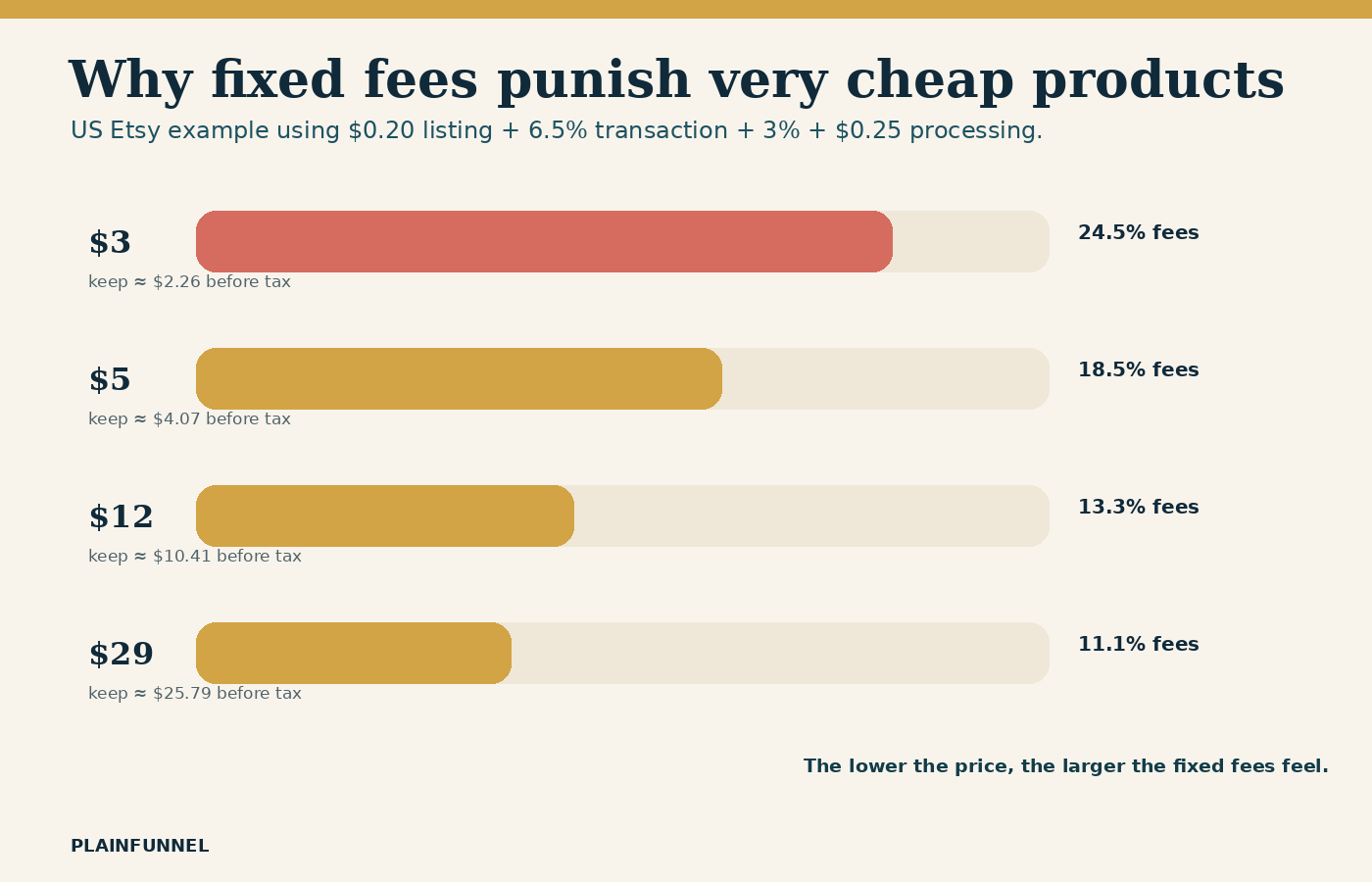
Nothing changed between those rows except the price. Same platform, same fee schedule, same product. A seller at $3 is handing over more than twice the share that a seller at $29 hands over, for identical work — and neither of them chose a different fee structure. One of them just priced under the floor where the flat fees stop mattering.
Percentage fees scale with your price. Flat fees don't. The lower your price, the more of your business the flat ones are quietly running.
The listing fee is charged whether or not anything sells, and a listing expires after four months. Unsold listings are effectively a small subscription. And Etsy states that fees are taken from *"the item's total sale price, including its shipping fees, and any applicable sales tax"* — so on a US sale where Etsy collects sales tax for you, you pay processing on tax money that was never yours.
What this means for $1,000 a month
Fee percentages are abstract. Traffic isn't. So let's run the step that almost every pricing article skips: converting a monthly income target into the number of visitors it requires.
Below, each price is taken all the way to genuine take-home — after fees, then after setting aside 30% for tax — and then divided into a $1,000/month target. The last column assumes a 2% conversion rate, meaning 2 of every 100 visitors buy.
| Your price | Take-home per sale | Sales/mo for $1,000 | Visitors/mo needed at 2% |
|---|---|---|---|
| $3 | $1.59 | 631 | ≈ 31,500 |
| $12 | $7.29 | 138 | ≈ 6,900 |
| $29 | $18.06 | 56 | ≈ 2,800 |
That's the whole article in one row comparison. The $3 seller and the $29 seller are chasing the same $1,000, but one of them needs roughly eleven times the traffic to get there. Not eleven times the effort on the product — eleven times the audience.
31,500 visitors a month to a product page is not a beginner number. It's a real content operation. If that's the traffic your price requires and you don't have a plan to produce it, the price is the thing that has to move, because the traffic won't.
The 2% column is a scenario, not a promise or a benchmark. Beginner advice tends to quote 2% as if it were a floor everyone clears; large ecommerce datasets vary widely by category, platform and traffic source, and none of them establishes a "digital product" rate you can borrow. So run the same table at several rates that fit your own traffic. The direction is what matters: at 1%, every traffic number above doubles — and at 0.5% it doubles again.
Change the price, the fee rate, and the conversion rate to yours — and see the traffic your own target actually needs.
Run your numbers for $1,000/moFree guide: the full step-by-step for taking one digital product from idea to a live listing — the real steps, the actual fees, and the numbers most guides skip. Get it free →
So should you just raise the price?
Here's the honest answer, and it's the part that gets left out: raising your price does not create demand. Nobody is standing by ready to buy at $29 just because you typed $29. If the product doesn't justify it, a higher price gets you fewer sales of a thing that still isn't selling, and you've learned nothing.
What the math does tell you is how much room you have to be wrong. Take-home per sale goes from $1.59 at $3 to $7.29 at $12 — about 4.6× more per unit. That means you could sell 78% fewer units at $12 and still end the month in the same place. You do not need the higher price to sell as well. You need it to sell about a fifth as well.
That's a testable question with a cheap answer, and it's a much better use of a month than adding twenty more $3 listings.
What to do this week
- Work out your real take-home per sale, not your price. Fees first, then a tax set-aside. That single number drives everything else.
- Convert your income target into a visitor count at a conversion rate you can defend. If the answer is tens of thousands of visitors a month, you've found your actual problem — and it isn't the product.
- Work out where your own flat-fee floor sits. There's no universal threshold — it depends on your platform's fixed charges and your economics. Run the fee table at your price and find the point where the fixed part stops being tolerable, because below it every discount you offer comes disproportionately out of your side.
- Read the three-star reviews on products like yours. They're written by people who almost liked something — they say precisely what was missing, which is what a higher price has to be built out of.
- Test one price change on one product, and give it long enough to mean anything. Changing five things at once tells you nothing about which one worked.
Does another platform fix this?
Not on its own, and it's worth being straight about this because we sell through Gumroad ourselves. Gumroad charges 10% + $0.50 on a direct sale — that's a flat fee too, and it behaves exactly the same way.
| Your price | You keep — headline fee | You keep — if processing is extra | Fee share of price |
|---|---|---|---|
| $3 | $2.20 | $1.81 | 26.7% – 39.6% |
| $9 | $7.60 | $7.04 | 15.6% – 21.8% |
| $29 | $25.60 | $24.46 | 11.7% – 15.7% |
Two of Gumroad's own pages currently describe this differently, and we can't reconcile them from the outside. Its pricing page presents 10% + $0.50 per transaction for direct sales as the fee. Its Help Center fees article states that this "does not include credit card processing or PayPal fees" — which would add roughly 2.9% + $0.30 on top. The left column is the headline figure; the right adds processing. Check your own payout for a real sale before planning around either, and treat the gap as the honest uncertainty it is rather than a number we've picked for you. Checked August 2026.
The ambiguity doesn't change the conclusion, which is the useful part: at $3 Gumroad is worse than Etsy on either reading, and at $29 the two are close enough that fees shouldn't decide it. No platform rescues a price whose fixed fees dominate it — the threshold just moves around. Choose on what actually differs: Etsy brings its own search traffic and you rent the marketplace relationship; Gumroad brings none and you keep the relationship. Gumroad has also acted as merchant of record since January 2025, handling sales-tax collection and remittance worldwide, which is a genuine administrative saving. Selling through Gumroad's Discover marketplace costs 30% instead.
The limits of everything above
- These are estimates, not your accounts. Payment processing varies by country, tax depends entirely on your situation, and platform fees change. Verify current rates before making a decision on them.
- Pricing is not the only reason a product doesn't sell, and it may not be yours. Plenty of $3 products would also fail at $29. The math tells you what a price *requires*; it can't tell you whether anyone wants the thing.
- Traffic is the hard part, and it's slow. Reaching steady monthly visitors on a new shop or site generally takes months of consistent work, and no pricing decision shortens that.
- Nothing here is a promise of income. These are the arithmetic consequences of numbers you supply. Change the inputs and the outputs change with them.
- Advertising costs sit on top. If you use Etsy's Offsite Ads, that's 15% of the order under $10,000 in sales, or 12% once you pass $10,000 in any 365-day period — and at that point participation is permanent for the life of the shop.
Is $3 ever the right price?
Yes, but as an entry point inside a larger funnel rather than as the business itself — something cheap that brings you a customer you can then sell to again, where the real economics live in what comes second. That only works if you own the customer relationship. As the whole business, $3 demands traffic that most sellers don't have.
Won't raising my price cost me sales?
Probably some, and the point of the math is to show how many you can afford to lose. Moving from $3 to $12 raises take-home per sale roughly 4.6×, so you'd need to keep only about 22% of your unit volume to break even. Whether the product supports the higher price is a separate question — test it rather than assuming either way.
Do the numbers here include tax?
The fee tables are after fees and before tax. The traffic tables set aside 30% for tax to reach genuine take-home. That 30% is a planning placeholder, not your rate — what you actually owe depends on where you live and how you're set up.
Where do the fee figures come from?
Etsy's and Gumroad's own published fee documentation, read directly rather than quoted from other articles, and last checked in August 2026. Rates change and vary by country, so treat them as a starting point and confirm against the platform before you rely on them.
Systems That Skip the Trial and Error
 Best value
Complete Digital Product Bundle
The Starter Kit, the Editable Templates Pack, and the Pinterest Traffic Pin Pack together — build your product, get 18 ready-to-sell templates, and drive free traffic. The templates alone are a $179 value.
See what's inside → Most popular
AI Digital-Product Starter Kit
Eight tools in one kit: launch playbook, validation checklist, planning worksheet, a 34-prompt AI pack, listing framework, launch tracker, 30-day traffic plan, and a Pinterest starter sheet.
See what's inside →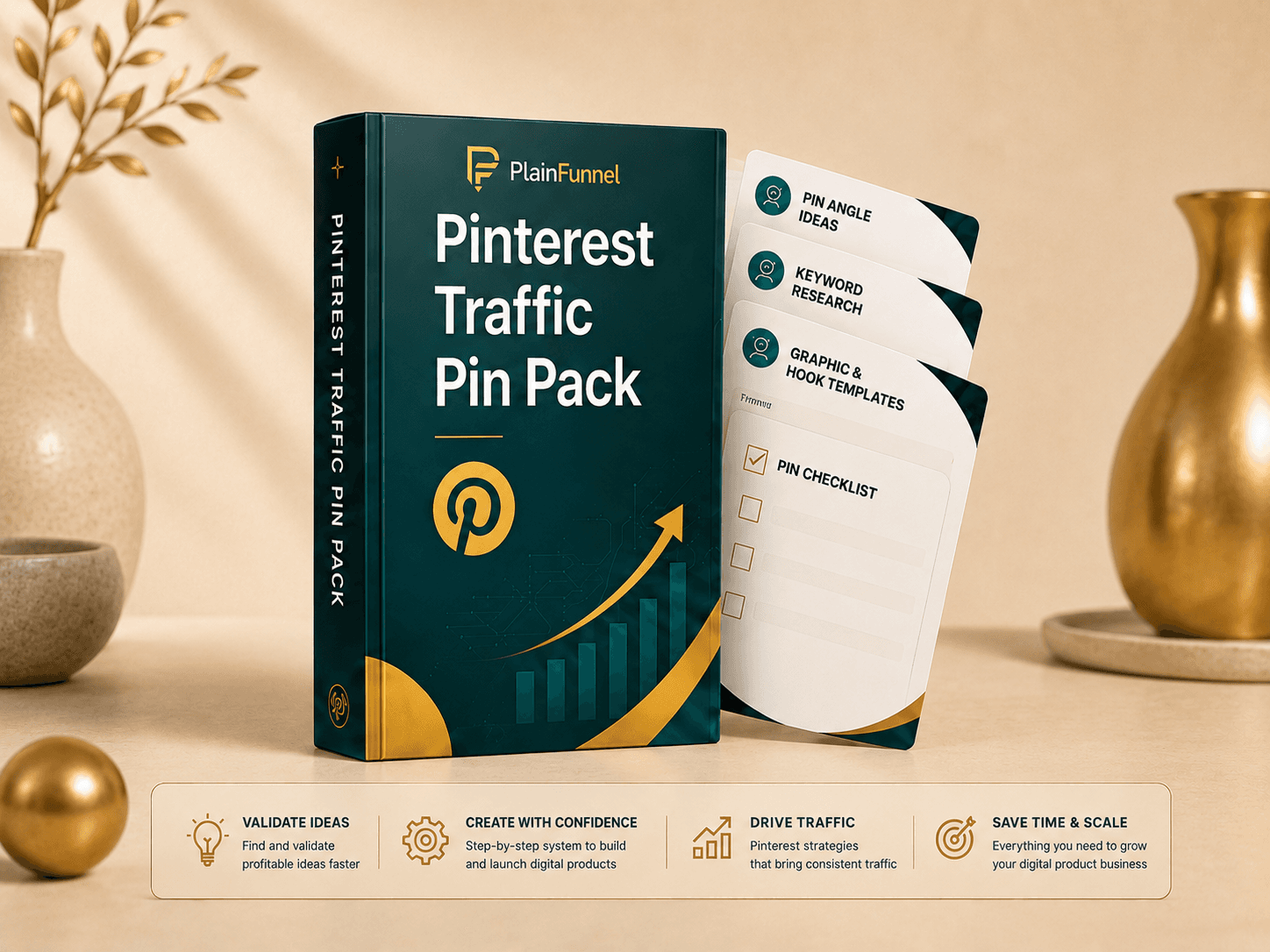
Pinterest Traffic Pin Pack
A 12-part Pinterest system: setup, angles, keywords, headline formulas, description prompts, a Canva Bulk-Create CSV, a destination audit, a 30-day calendar, troubleshooting, and worked examples — to turn one product into a month of free search traffic.
See what's inside →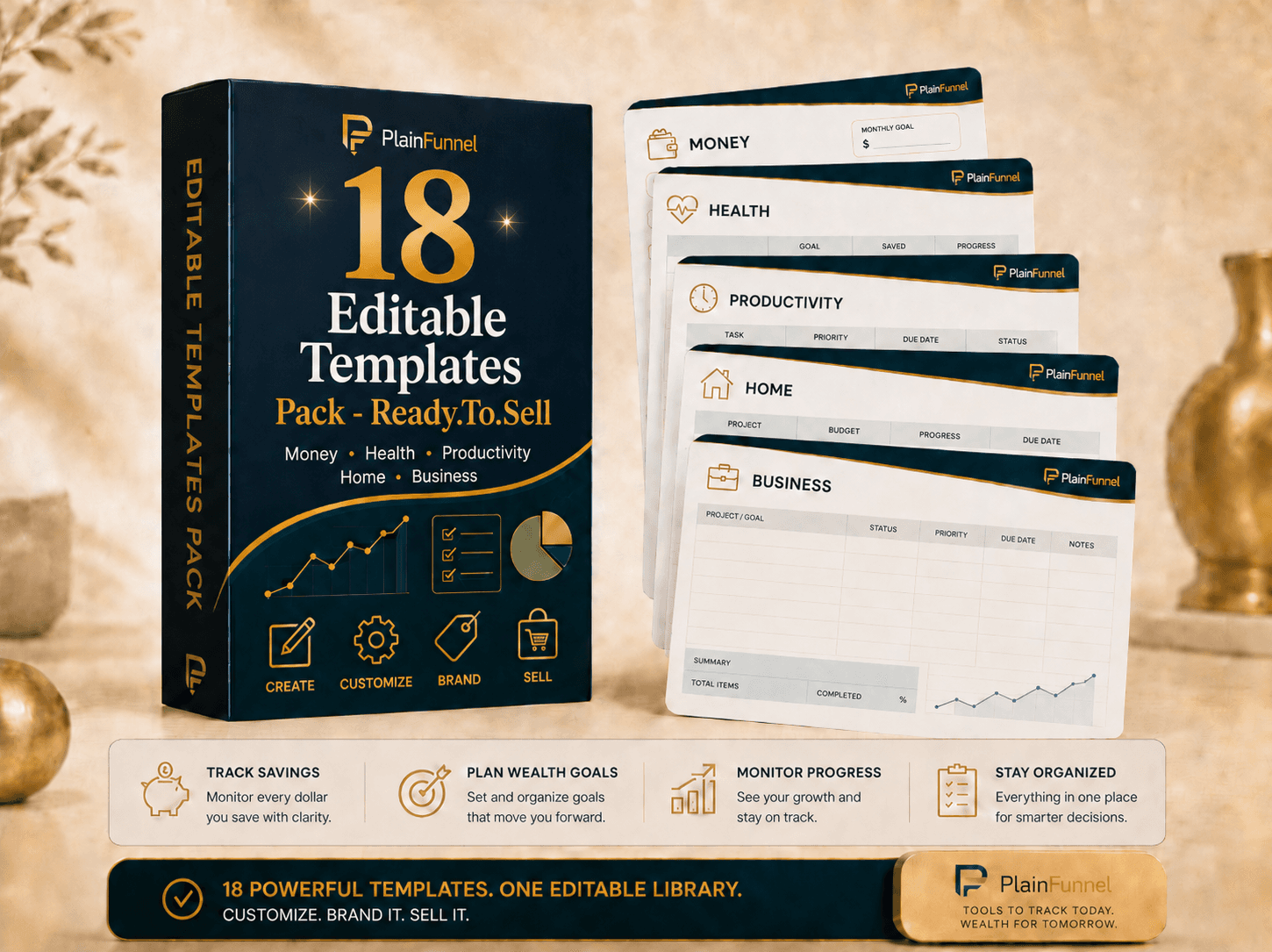
Editable Templates Pack
18 ready-to-sell templates across money, health, productivity, home, and business — planners, trackers, and worksheets. Customize the colors, examples, and branding, then list them as your own products. Print-ready PDFs + editable spreadsheet versions.
See what's inside →
AI Prompt Pack: Idea → Listing
The tested prompts that take you from blank screen to a finished, listable product — images, titles, and descriptions that don't read like AI wrote them.
See what's inside →Working out the pricing floor is the easy half. The tedious half is everything after it — the listing structure, the keyword research, the file setup, the product decisions that determine whether a higher price is defensible. That's the part we packaged, so it doesn't cost you a month of guessing.
Related guides
- How to sell AI digital products on Etsy — the listing this pricing decision sits inside.
- Pinterest pins that drive traffic — the traffic half of the equation above.
We sell digital products and we sell through Gumroad, so we have a commercial interest in this topic — which is why the Gumroad fees are laid out above rather than left out. Etsy and Gumroad are independent companies with no relationship to us. Fees and policies change; verify current rates before deciding anything. Educational only, not financial or tax advice, and no income claims.
Get the honest digital-products starter guide
The full step-by-step from PlainFunnel — free, no hype.