I Spent Days Making a Digital Product and Nobody Bought It. Here's What I'd Check First.
Everyone says "validate first" and nobody says how to measure it. Here's what validation actually looks like — including the free research most sellers walk past, and the traffic question you have to answer before you conclude that nobody wanted it.
Two different things get called "nobody bought it", and they need opposite fixes. Not enough people saw it is a traffic problem, and at realistic conversion rates a few dozen views is not evidence of anything. People saw it and passed is a demand problem — and demand is checkable before you build, in an afternoon, using research that is free and public. Most sellers skip it because checking feels like procrastination while building feels like progress.
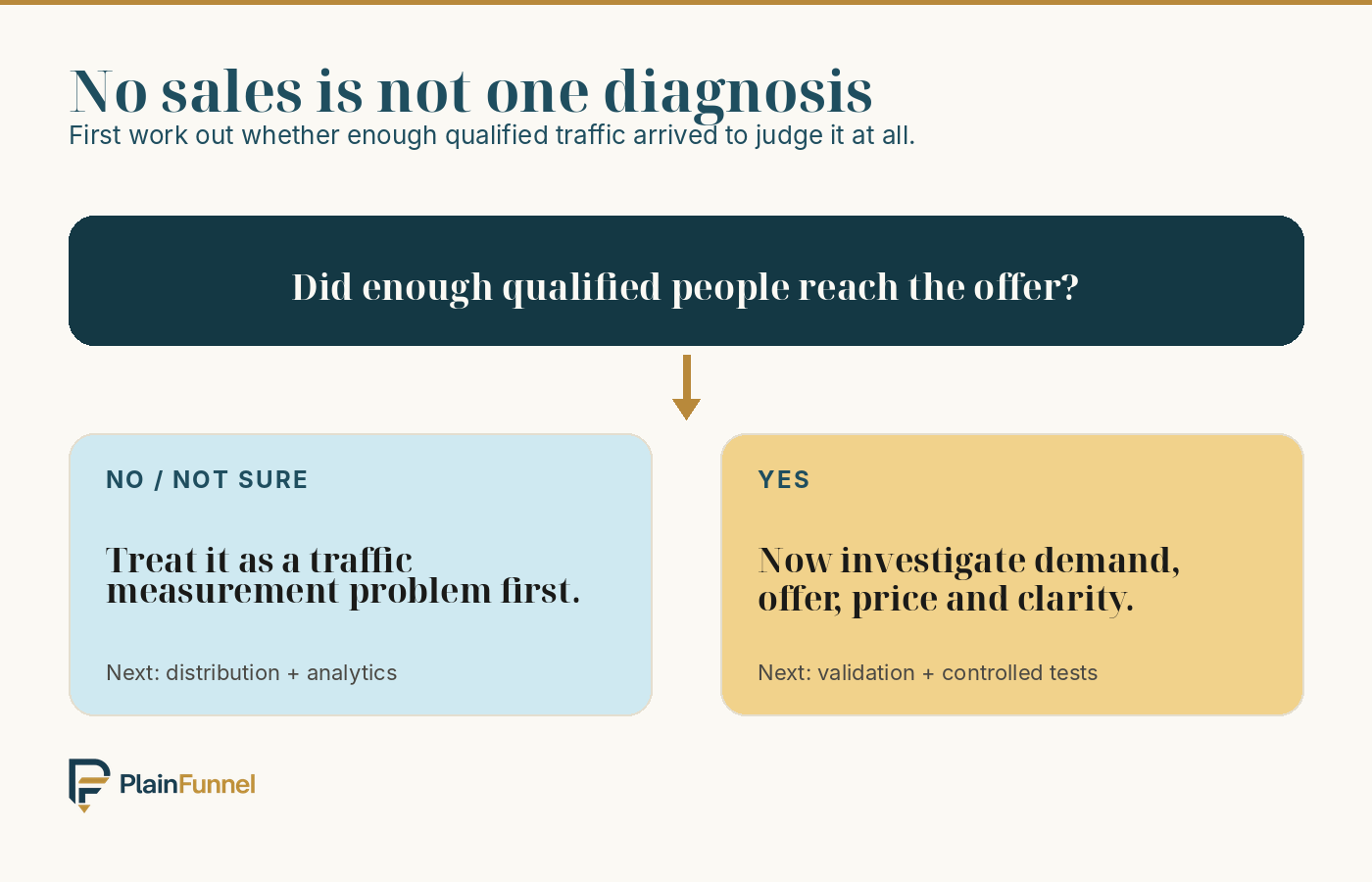
The worst moment in this whole business
You had an idea. You spent a weekend on it, maybe several. You made the file, you wrote the description, you picked a price, you hit publish — and then nothing happened. Not a slow start. Nothing.
It's a uniquely deflating experience, because the work was real and the result is a zero. And the advice you find afterwards is almost useless: validate your idea first. Everyone says it. Almost nobody says what it means, what you'd measure, or what result would have told you to stop.
"Find a low-competition niche" is repeated like it's a number you can look up. It isn't one.
First: did anyone actually see it?
Before concluding that nobody wanted the thing, find out how many people were ever in a position to want it. This is the step that gets skipped, and it changes the diagnosis completely.
There is no reliable universal conversion rate for digital products, and anyone who quotes you one for your situation is guessing — published ecommerce figures swing widely by category, platform, traffic source and device. What you can do is take a few plausible rates as scenarios and see how much traffic each one needs before a single sale is even *likely*:
| If your conversion rate is… | Visitors before one expected sale | What that looks like |
|---|---|---|
| 0.5% (pessimistic) | ≈ 200 | Weeks of a quiet new listing |
| 1% (middling) | ≈ 100 | A decent week on one channel |
| 2% (optimistic) | ≈ 50 | A listing that's already working |
Those three rates are illustrative columns chosen to bracket the question, not a claim about what your product should achieve. If your own analytics already give you a rate, use that instead — and if they don't, finding out is a better use of an afternoon than borrowing an average from an article.
So if your product got 40 views and no sales, you have not learned that nobody wants it. You've learned almost nothing at all. Forty views is a sample too small to carry a conclusion, and treating it as a verdict is how good ideas get abandoned and bad ones get rebuilt.
Even at exactly the traffic where you'd *expect* one sale, seeing zero is completely ordinary. On a simple model where each visitor decides independently, the chance of no sales at that point is about 36% — better than one in three, and it barely moves whichever of the three rates above you use. Two quiet weeks at low traffic is not a signal. It's noise, and acting on it is how sellers end up rewriting a listing that was fine.
So the first question isn't "why didn't it sell?" It's "how many people saw it, and is that enough to mean anything yet?" If the answer is a few dozen, your problem is distribution, and no amount of product work will fix it.
Work out how many visitors your price and conversion rate actually require before a sale is likely — with your numbers, not these.
Run the traffic mathFour things that feel like validation and aren't
If people did see it and still didn't buy, then it's worth looking at what you checked before you built. In practice, most pre-launch confidence rests on one of these four, and none of them is evidence.
- "My friends said it was a great idea." They aren't the buyer, and they're being kind — which is what friends are for. A compliment costs nothing; that's precisely why it carries so little information. Behaviour is stronger evidence than approval: what people have already paid a competitor for, what they search for repeatedly, what they join a waitlist or pre-order for. All of that beats "sounds good to me."
- "There's nothing else like it." This feels like a gap and is usually a verdict. Competitors are the cheapest possible proof that buyers exist and will pay. An empty category more often means somebody already tried and it didn't work.
- "It's a huge niche." Market size isn't demand for your specific thing. Millions of people cook dinner; that says nothing about whether anyone wants your meal planner in particular.
- "I put a lot of work into it." The hardest one to let go of, because it feels like it should count. Effort is an input. Buyers are only ever responding to the output, and they have no way to see what it cost you.
What validation actually looks like
Real validation is small, concrete, and finishable in an afternoon. It is not a phase. Here's the sequence, in the order that saves the most wasted work.
- Check the phrase, not the niche. Niches are abstractions; phrases are what people type. Take the specific thing you want to make and find out whether anyone searches for it in those words. Our free Product Idea Finder pulls the real phrases people use — if the words you'd put in a title don't appear anywhere, that's your first answer.
- Go looking for competitors, and hope you find some. Search the phrase and count what comes back. Several products selling, with reviews and recent activity, is the best news you can get: it means the buyer exists, the price is established, and you don't have to create the demand — only serve it better.
- Read the three-star reviews. This is the highest-signal free research available to you, and almost nobody does it. More on it below.
- Check the price floor. Work out what the product would have to charge to be worth making, and whether that price is plausible for this category. A validated idea that can only carry $3 is a different business to one that can carry $29 — here's the arithmetic on why.
- Write the promise in one line, before you build anything. "This helps [who] do [what] without [the annoying part]." If you can't write that sentence, the product isn't clear enough yet — and the description you'd have to write later will be just as vague.
- Decide the stop rule now. Write down, in advance, the result that would make you *not* build this. Without one you aren't validating; you're collecting permission.
Why the three-star reviews are the whole trick
Reviews on competing products are free, public, written by verified buyers in the exact category you're entering — and the useful ones are not the extremes.
| Rating | Who writes it | What you can actually use |
|---|---|---|
| 5 star | People who already wanted this | Confirms the category, not your version |
| 4 star | Satisfied, with one reservation | Occasionally names a real gap |
| 3 star | People who almost liked it | Exactly what was missing — your product brief |
| 2 star | Wrong expectations, or a real defect | Usually a listing-clarity problem |
| 1 star | Delivery, file, or support failures | Operational warnings, rarely product ideas |
Five-star reviews tell you people like the category. One-star reviews tell you somebody's download link broke. Three-star reviews are written by people who paid, used the thing, and came away thinking it was fine but incomplete — and they will tell you, unprompted and in detail, exactly which part was missing.
Read twenty of them across the closest three or four products and the same two or three complaints will repeat. That repetition gives you a strong product hypothesis — a gap that paying customers keep saying is unresolved, written down by people who already spent money in the category. It is far better evidence than brainstorming, and it is still not proof that they'll buy *your* version. It's the thing you take to a market test, not a substitute for one.
The demand, competition, price and delivery questions to answer before you spend another weekend building — one page, free.
Get the validation checklistWhat to do this week
- Find your view count. Etsy, Gumroad and Pinterest all report it. Write the number down before you form any opinion about why it didn't sell.
- Decide your traffic threshold before you look at the result, using the scenario table above — the number of visitors at which a run of zero would genuinely surprise you. Until you've hit it, stop rebuilding the product; the sample can't tell noise from signal yet.
- If it did get real traffic, read twenty three-star reviews on the closest competing products and write down every repeated complaint.
- Rewrite your first line as the outcome, not the format. Nobody buys "a 24-page PDF"; they buy the afternoon it saves them.
- Fix the single most-repeated gap and relist. One change, long enough to read the result.
The limits of all this
- Validation reduces risk; it doesn't remove it. Products that pass every check above still fail. The point is to fail in an afternoon instead of over a weekend, and to know which assumption broke.
- Some real demand is invisible to search. If a problem is new, or people don't have a name for it, keyword tools will show nothing and the demand can still be there. Search evidence is strong when present and weak when absent — treat an empty result as a caution, not a verdict.
- Validation can't rescue an unclear listing. A well-validated idea with a vague promise and a bad title still doesn't sell, and it will look exactly like a demand problem when it isn't.
- Reviews describe the past. They tell you what buyers wanted from products that already exist. They can't tell you what nobody has thought to ask for yet.
- Nothing here is a promise of sales. Conversion figures are published benchmarks, not your numbers, and every product and channel behaves differently.
How many views should I have before deciding it failed?
Enough that zero sales would genuinely surprise you — and that depends on a rate you choose in advance, not on a number we can give you. Work it out from the scenario table above, or from your own analytics if you have them. The useful habit is picking the threshold before you see the result, so you're not rationalising afterwards.
Isn't validating just procrastinating?
It's the opposite, though it doesn't feel that way — building is visibly productive and checking isn't. The sequence above is an afternoon. The product it stops you making is a weekend, plus the listing, plus the month you spend wondering why it didn't sell.
What if there's lots of competition already?
That's usually good news. Competition proves buyers exist, establishes what they'll pay, and hands you a public list of complaints to build against. The hard version of this business is creating demand; the workable version is serving demand somebody else already proved.
Should I just ask people if they'd buy it?
Ask what they've already done, not what they would do. "Have you ever paid for something to solve this?" and "what did you use last time?" produce evidence. "Would you buy this?" produces politeness, and politeness has cost a lot of people a weekend.
Where do the conversion figures come from?
They aren't benchmarks and we don't present them as any — they're three illustrative rates chosen to bracket the question. We deliberately don't quote a "digital product average", because the published ecommerce figures vary so widely by category, platform and traffic source that a single number would be false precision. Your own analytics beat any of them.
Skip the Trial and Error
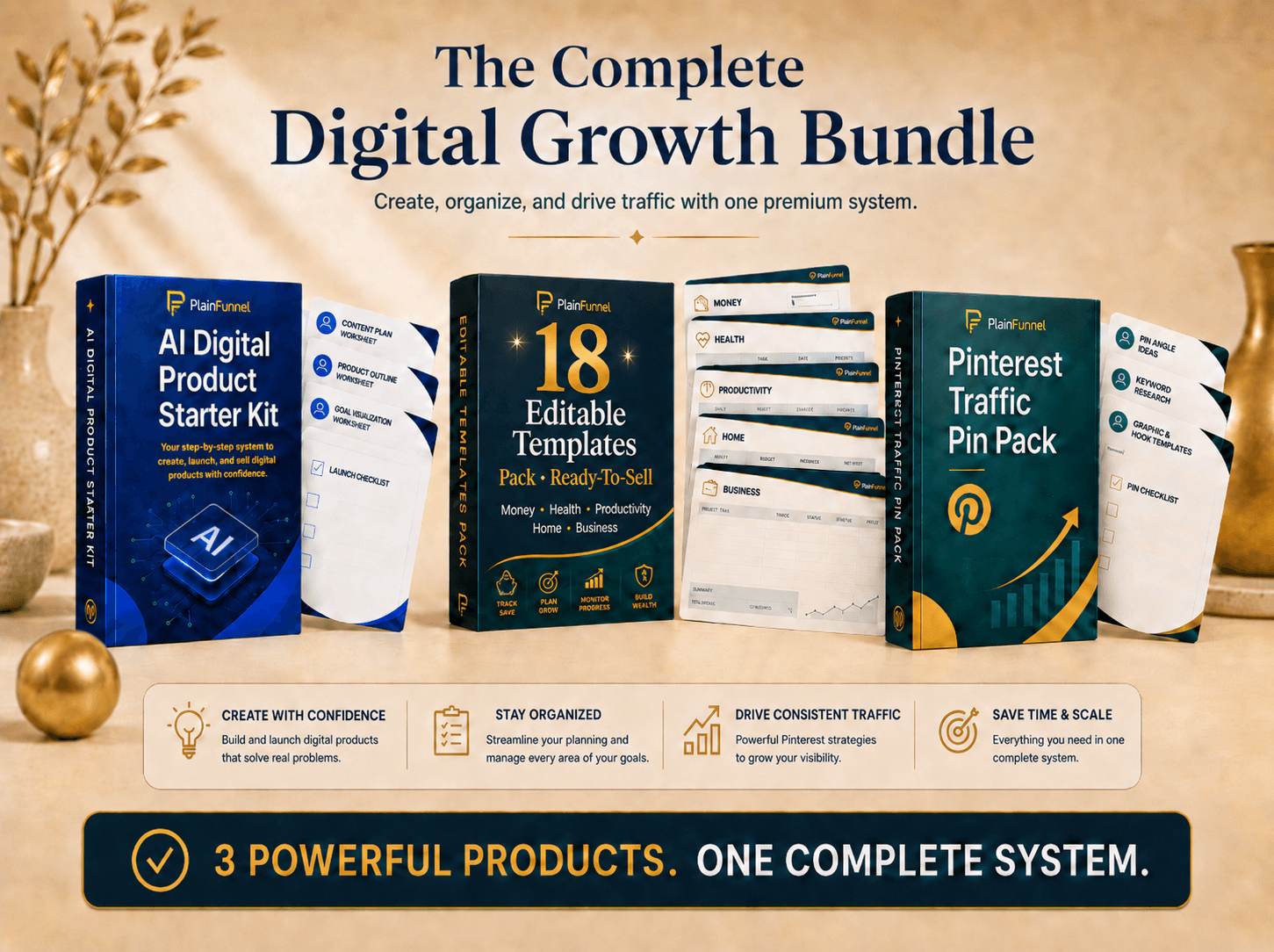 Best value
Complete Digital Product Bundle
The Starter Kit, the Editable Templates Pack, and the Pinterest Traffic Pin Pack together — build your product, get 18 ready-to-sell templates, and drive free traffic. The templates alone are a $179 value.
See what's inside →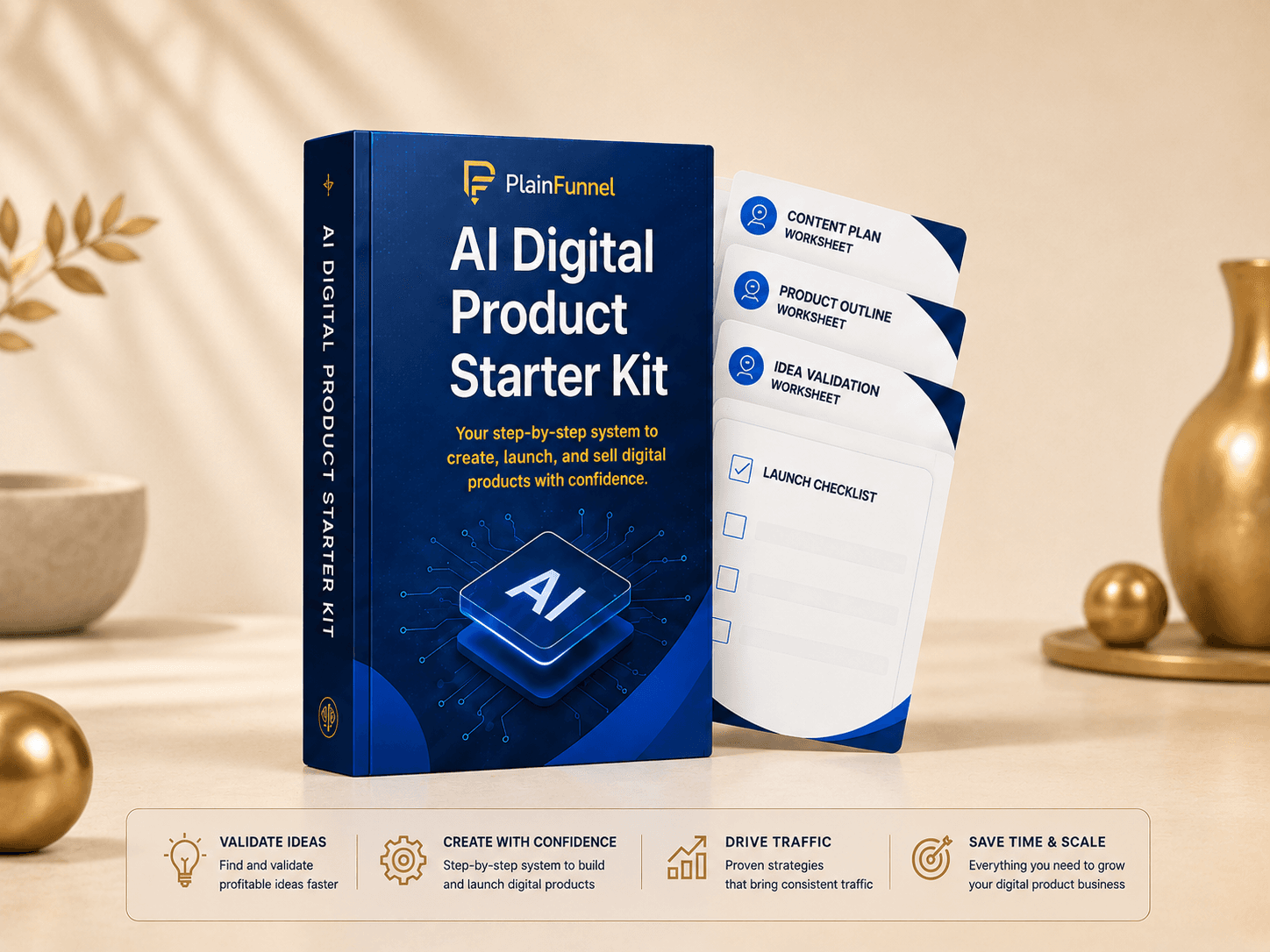 Most popular
AI Digital-Product Starter Kit
Eight tools in one kit: launch playbook, validation checklist, planning worksheet, a 34-prompt AI pack, listing framework, launch tracker, 30-day traffic plan, and a Pinterest starter sheet.
See what's inside →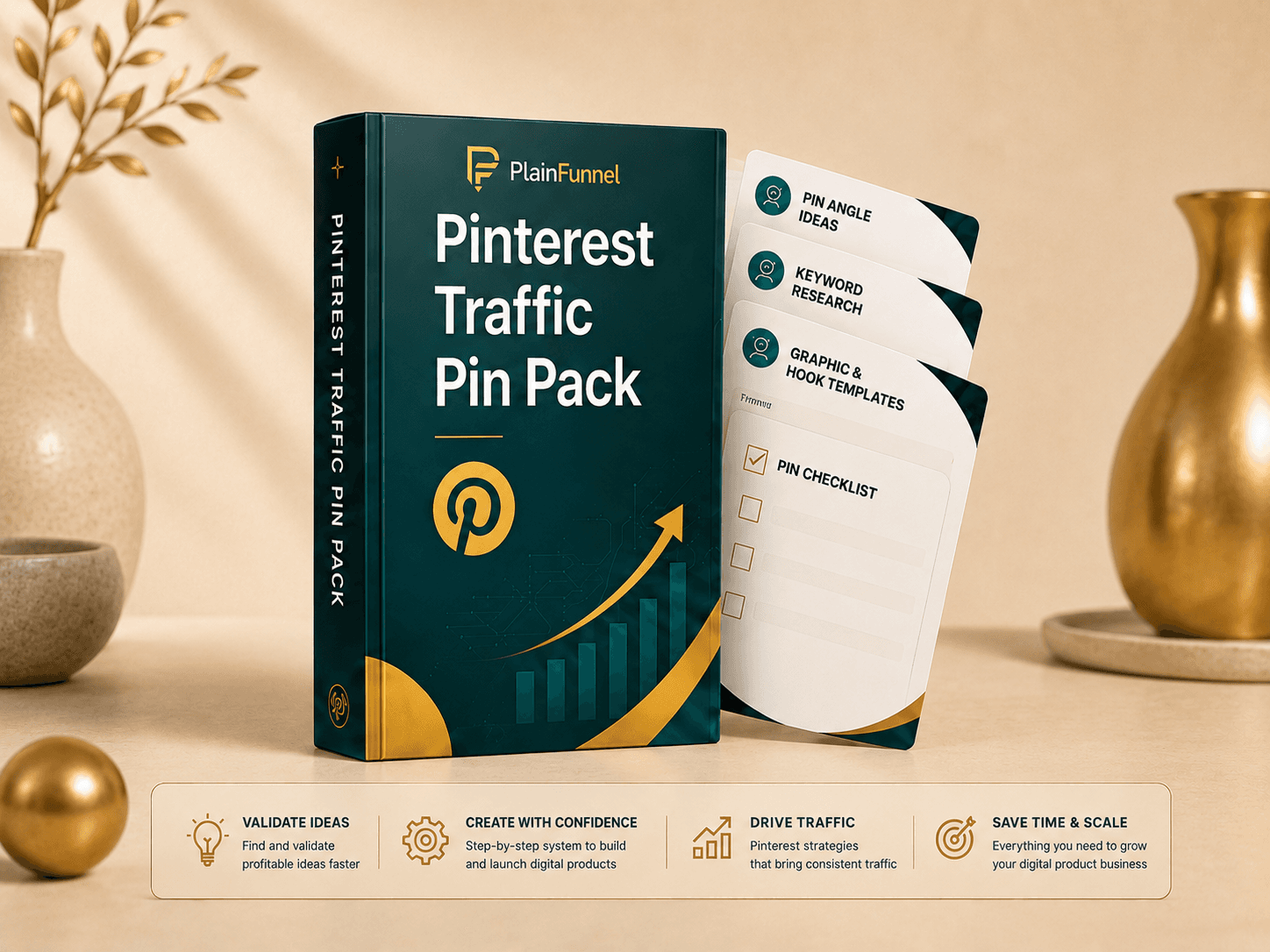
Pinterest Traffic Pin Pack
A 12-part Pinterest system: setup, angles, keywords, headline formulas, description prompts, a Canva Bulk-Create CSV, a destination audit, a 30-day calendar, troubleshooting, and worked examples — to turn one product into a month of free search traffic.
See what's inside →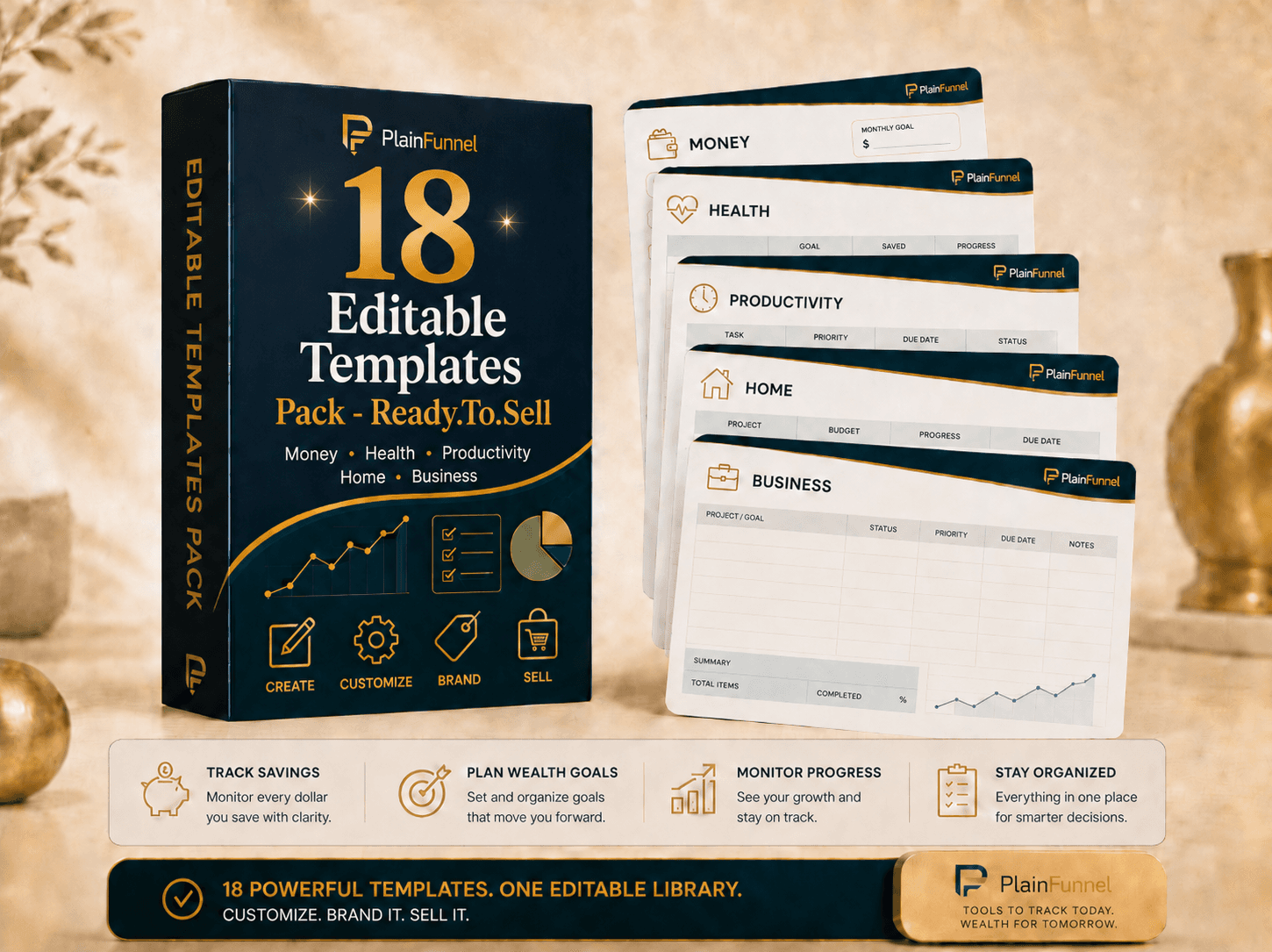
Editable Templates Pack
18 ready-to-sell templates across money, health, productivity, home, and business — planners, trackers, and worksheets. Customize the colors, examples, and branding, then list them as your own products. Print-ready PDFs + editable spreadsheet versions.
See what's inside →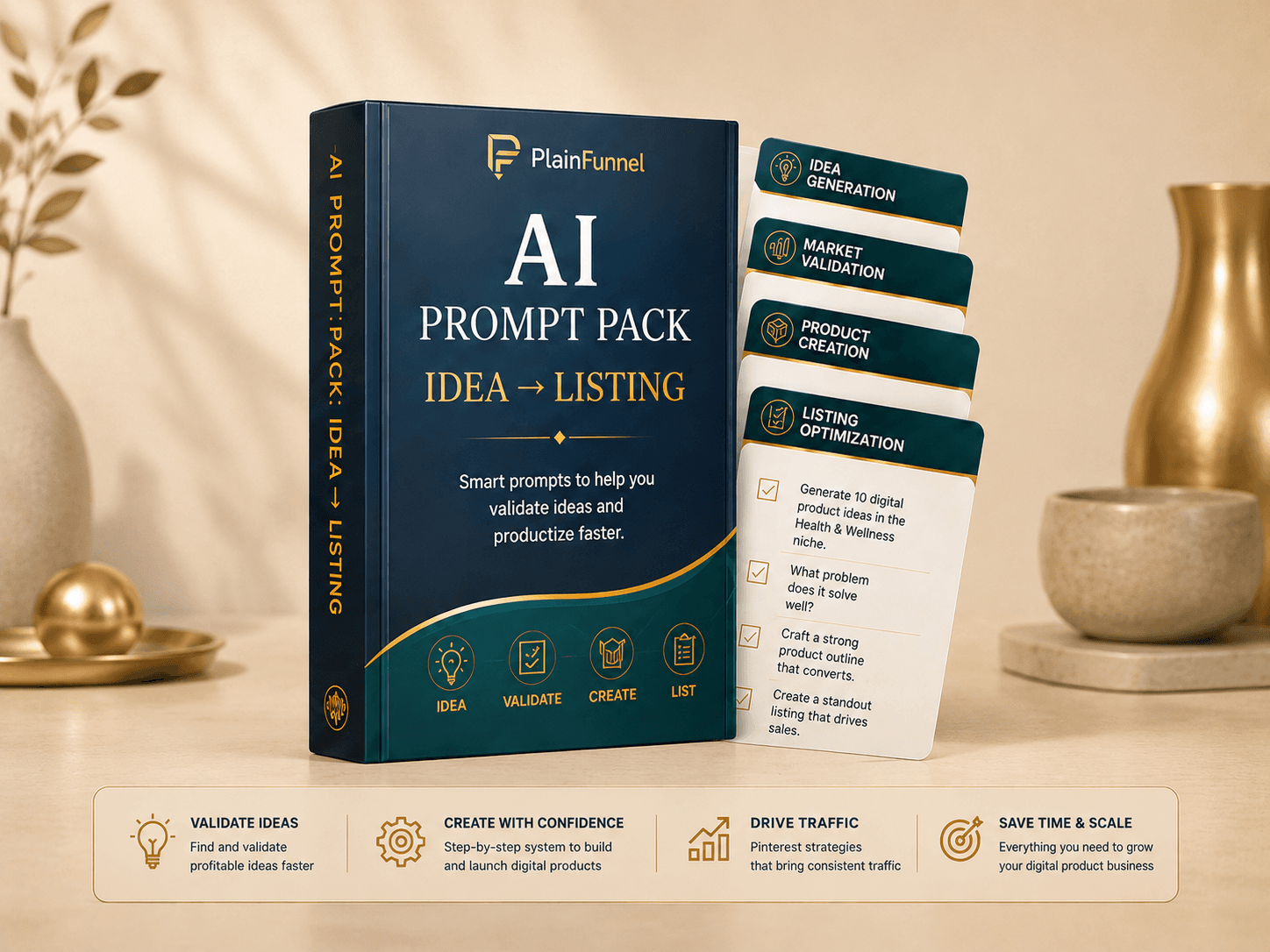
AI Prompt Pack: Idea → Listing
The tested prompts that take you from blank screen to a finished, listable product — images, titles, and descriptions that don't read like AI wrote them.
See what's inside →Checking an idea is the fast part. The slow part is everything after it — the listing structure, the file setup, the prompts that get a first draft finished, the launch sequence. That's the part we packaged, so it doesn't cost you a month of guessing at it.
Related guides
- I priced it at $3 and I'm barely making anything — what a price has to do, and the traffic each one requires.
- How to sell AI digital products on Etsy — the listing a validated idea ends up inside.
- Pinterest pins that drive traffic — the distribution half, if your problem turned out to be views.
We sell digital products, so we have a commercial interest in this topic. The validation sequence above is free and works without buying anything from us — the checklist simply puts it on one page. Etsy, Gumroad and Pinterest are independent companies with no relationship to us. Educational only, no income claims.
Check the idea before you build it
The Product Idea Validation Checklist — the questions to answer before you spend a weekend making something nobody searches for. Free.